
September 7, 2026 - Today, our paper titled “Mixed-Precision GPU Acceleration of RTE-RRTMGP-CPP: Towards Radiative Transfer Simulations on Exascale Supercomputers” was published in the journal Procedia Computer Science as part of the proceedings of the fourth EuroHPC User Days Meeting.
In this paper, we investigate the impact of using mixed-precision techniques to improve the performance of RTE+RRTMGP-CPP, an application that is widely-used to compute both solar and thermal radiation in the atmosphere as part of many weather and climate simulations. We are using Kernel Float to create new implementations of the CUDA kernels in RTE+RRTMGP-CPP in which we can easily change the precision used for various data types and computations. Then, Kernel Tuner is used to automatically search the combined design space of many different precision levels as well as other code optimizations in the kernels. Using the recently published extentions of Kernel Tuner, we can search for specific implementations of the application that optimally trade numerical accuracy for improved performance.
This work is part of the ESiWACE3 project.
The full paper is available at https://doi.org/10.1016/j.procs.2026.08.023.
Abstract
Radiative transfer is a fundamental component of weather and climate modeling, often accounting for a significant portion of total simulation time in Earth System Models (ESMs). RTE+RRTMGP-CPP is a C++ frontend as well as a CUDA-based implementation of the Radiative Transfer for Energetics (RTE) solver and the Rapid Radiative Transfer Model (RRTMGP), both widely used to compute longwave and shortwave radiative transfer in vertical columns of atmospheric models. However, despite existing GPU acceleration, high computational intensity remains a bottleneck for scalability on modern supercomputers.
In this work, we present a scalable, mixed-precision implementation of RTE-RRTMGP-CPP. Driven by recent advances in machine learning, GPU manufacturers have integrated specialized low-precision hardware units offering significantly higher throughput and energy efficiency than traditional 64-bit floating-point numbers. By selectively integrating these low-precision data types and arithmetic in performance-critical GPU kernels of RTE-RRTMGP-CPP, we improve computational efficiency while maintaining scientific accuracy within an acceptable tolerance. Using automatic precision tuning, we are able to find multiple configurations of the application that provide Pareto-optimal trade-offs between numerical accuracy and execution speed.
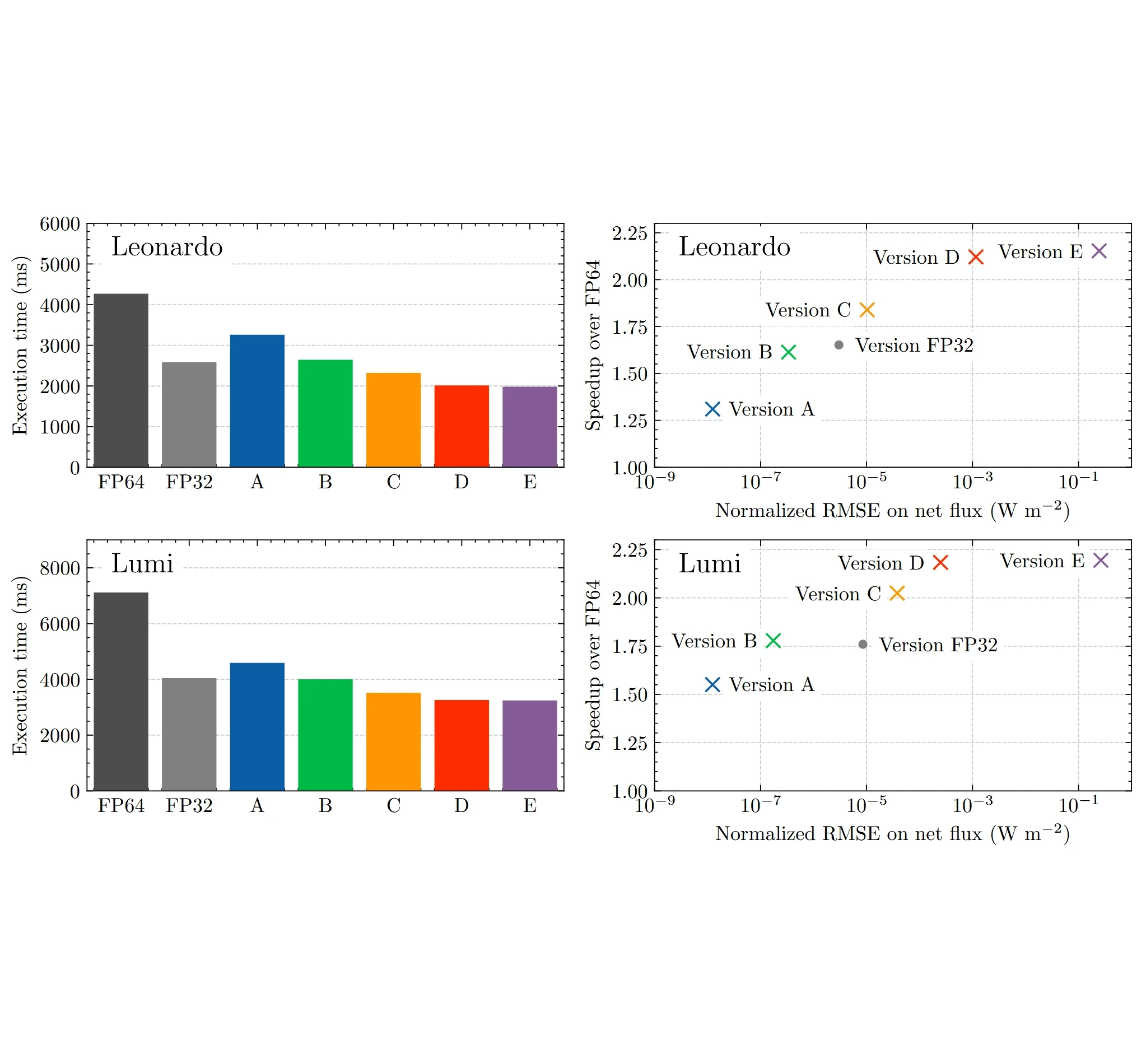
Our results show that mixed-precision tuning accelerates the radiative transfer solver, achieving speedups of up to 2.1 × on Leonardo (NVIDIA A100) and 2.2 × on LUMI (AMD MI250X) compared to double precision and carefully selected configurations offer attractive performance-accuracy trade-offs compared to uniform single precision. Overall, this work demonstrates how to exploit the low-precision capabilities of modern GPUs and prepare weather and climate models for upcoming exascale systems.
Citation
Stijn Heldens, Alessio Sclocco, Gijs van den Oord, Ben van Werkhoven, Chiel van Heerwaarden, Erwan Raffin, Xavier Yepes-Arbós “Mixed-Precision GPU Acceleration of RTE-RRTMGP-CPP: Towards Radiative Transfer Simulations on Exascale Supercomputers” Procedia Computer Science, Volume 286, Pages 95-105, 2026 https://doi.org/10.1016/j.procs.2026.08.023