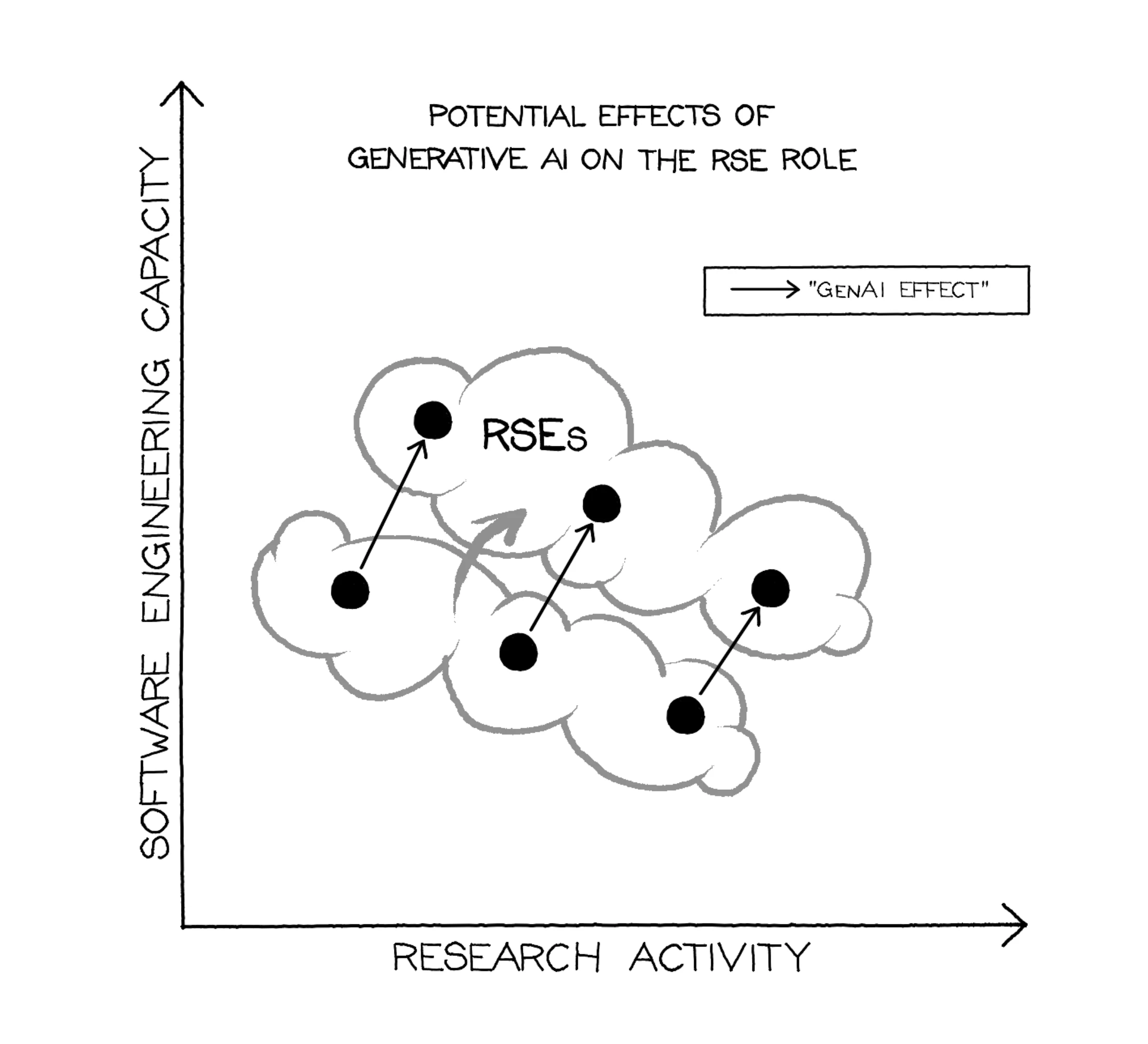
May 28, 2026 — Today, an article was published that we set out to write at the workshop on Research Software Engineering in the Age of Generative AI held in March 2026 in Edinburgh. The article explores how Research Software Engineers (RSEs) are using generative AI to expand their capacity across both software engineering and research work, and offers a way to visualize this shift in practice. Its central message: even as generative AI reshapes how RSEs work day to day, the value they bring to research remains steady and is likely to grow.
Abstract
Research software and its creators have long played a critical role in the advancement of research worldwide. This role is changing in the age of “generative AI” (GenAI), but both the software and the people remain of key importance. Understanding these changes is essential in enabling Research Software Engineers (RSEs) to continue contributing the same high value to the research process and its outputs.
Before GenAI, the RSE movement had learned to clearly articulate the value proposition of embedding expert software engineering in research to its stakeholders. This blog post highlights how RSEs use GenAI to increase their capacity in both software engineering and research, and visualize this evolution. While GenAI is changing - perhaps considerably - how RSEs work in practice, their value and the value of their work for research remains steady and likely to increase.
Citation
Stephan Druskat, Michelle Barker, Ian Cosden, Cunliang Geng, Robert Haines, Daniel S. Katz, Joseph Shingleton, Ben van Werkhoven “Research Software Engineers in the Age of GenAI: Same Value, Changing Practice” https://doi.org/10.5281/zenodo.20320178